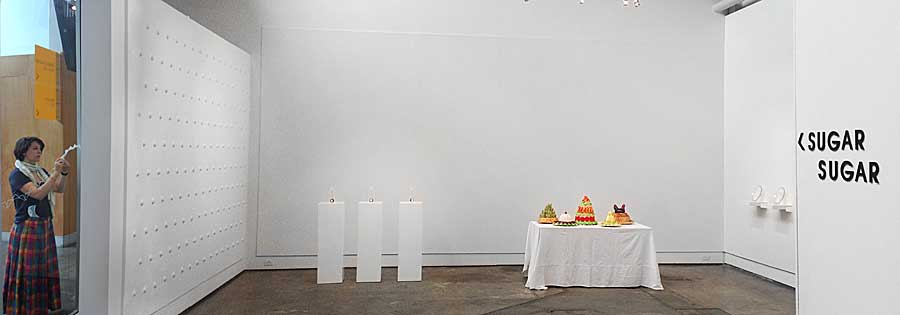
Ken and Julia Yonetani / Janet Tavener, Artlink, vol 31 no.2, 2011, p.156
Contributor: Gastro-Vision: The Best in Food-Art 2010, Art21, 17 December 2010
Fast Food through the Lens of Still Life Photographers, Curator, 12 November 2010
Ken and Julia Yonetani / Janet Tavener, Artlink, vol 31 no.2, 2011, p.156
Contributor: Gastro-Vision: The Best in Food-Art 2010, Art21, 17 December 2010
Fast Food through the Lens of Still Life Photographers, Curator, 12 November 2010
Set against the slate gray skies of winter, the kitchen calls. With my hip pressed against the counter and the trusty wooden spoon I found in the back of a drawer in my first London home, I stand and stir with wafts of steam creating a makeshift heater. In the midst of the season of soup, I have swirled pots of stock until the freezer was brimming. Slowly caramelizing onions is a satisfactory substitute to soup-making; it is a long process that continues to warm the kitchen during the last of the chilly days.

De Scott Evans, A Plate of Onions, 1889
oil on canvas, 25.4 x 30.4 cm
In the most basic sense, Egg and cauliflower still life by George Lambert is a study in texture. The bulging florets of cauliflower are offset by the smooth shell of the egg. In a memorable dish, the combination of texture is just as important as the fusion of flavour. Taking a cue from Lambert’s textural investigation, the recipe for pan-fried buttered cauliflower with a poached egg seeks to maintain the differences in texture in the resulting dish. By roughly chopping the cauliflower into a range of sizes, the contrast in shape allows the smaller fragments to become dark and crispy while the larger florets maintain their form and become soft to the tooth. The almonds add a bit more crunch and the poached egg provides a luxuriously smooth sauce. Cobbled together in less that twenty minutes, the dish works equally well as the centerpiece of a weekend brunch or a quick weeknight meal.
George Lambert, Egg and cauliflower still life, 1926
oil on canvas, 34.3 x 44.1 cm, Art Gallery of South Australia
Adorning the cloaks and garments of royalty, the colour purple was often called imperial purple due to the close association. The word purple is a derivative of the original Greek porphura, the name of the Tyrian purple dye of antiquity extracted from a spiny snail. The pigment was extremely expensive to produce and only the very wealthy could afford clothes dyed the colour of grapes and plums. As a secondary colour, purple is wedged between red and blue on the colour wheel. The tones leaning towards the blue side of the spectrum were desired due to their association with the rare blue pigment favoured by artists and craftsmen.

Benjamin Roberts, Still life of plums with a cabbage white, 1862
oil on board, 16 x 21.5 cm, Private collection
‘What’s Cooking Uncle Sam‘ is the newest exhibition on view at the National Archives in Washington DC. It is a show that traces the government’s role in both food production and consumption of the Unites States. The exhibition features a collection of office stationery ranging from posters and pamphlets to product labels and photographs of the various meals enjoyed by Presidents. I asked the curator, Alice Kamps, a few questions regarding the National Archives collection and the exhibition which will be on view until the 3rd of January.
Left: Heinz’s Ketchup Label, 1883, National Archives, Records of the Patent & Trademark Office
Right: Vitamin Doughnuts Poster, 1942,
National Archives, Records of the Agricultural Marketing Service